
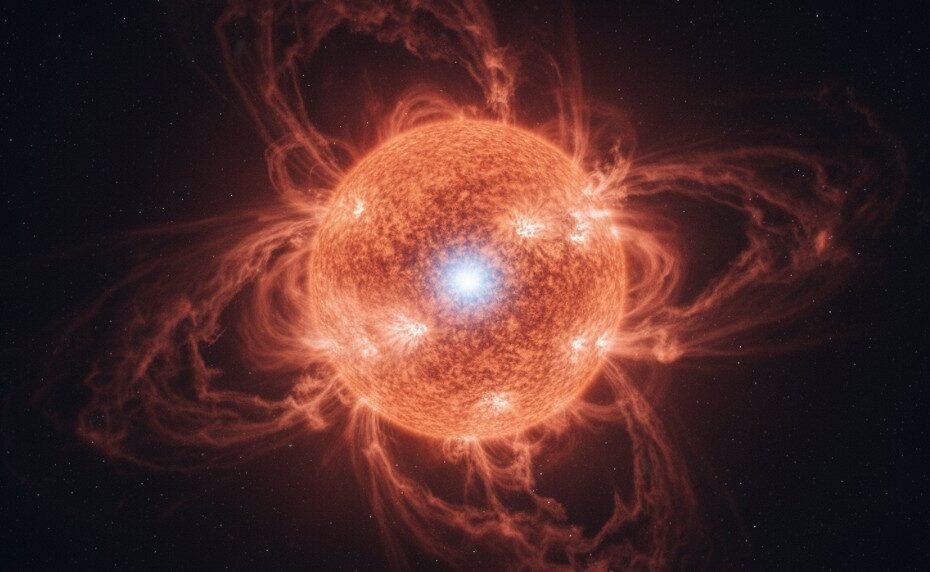
Is the sun burning out, and what happens when it does? This question sparks curiosity about our star’s future and Earth’s ultimate destiny.
While the sun’s light feels like a fire, the truth is far more fascinating and doesn’t involve any burning at all.
Key Takeaways
- Not Fire, But Fusion: The sun generates energy through nuclear fusion, not chemical burning. It fuses hydrogen into helium in its core and doesn’t require oxygen.
- 5 Billion Years Left: The sun is a middle-aged star and has enough hydrogen fuel to remain in its current, stable phase for another 5 billion years.
- A Quiet End, Not an Explosion: The sun is too small to go supernova. It will eventually swell into a red giant, shed its outer layers, and shrink into a cool, dense white dwarf.
- Earth’s Clock is Ticking Faster: While the sun has billions of years left, its increasing brightness will boil Earth’s oceans and make our planet uninhabitable in about 1 billion years.
Is the Sun Burning Out? Like actually “On Fire”?
It’s a common misconception to picture the sun as a giant bonfire in space. However, this isn’t the case. The intense energy it radiates comes from a process that is fundamentally different from the chemical burning we see on Earth.
The Difference Between Burning and Fusion
When a log burns in a fireplace, it’s undergoing a chemical reaction called combustion. This process requires a fuel source (wood) and an oxidizer (oxygen) to release energy. The sun, however, operates in the vacuum of space where oxygen is virtually nonexistent.
Instead, the sun’s engine is powered by nuclear fusion. In the sun’s core, immense gravitational pressure and temperatures reaching 27 million degrees Fahrenheit (15 million Celsius) are so extreme that they force hydrogen atoms to fuse together, creating helium.
This nuclear reaction releases a colossal amount of energy in the form of heat and light, as described by Einstein’s famous equation, E=mc². This is the energy that sustains all life on Earth.
So, How Does the Sun ‘Burn’ in Space Without Oxygen?
To put it simply, it doesn’t. Since the sun’s energy source is nuclear fusion, oxygen is not a required ingredient. Consequently, the sun can continue to generate heat and light in the complete vacuum of space for billions of years, a feat impossible for a traditional fire.
A Look Inside the Sun: Its Composition and Core
To truly understand our star, we need to look at its ingredients. The sun is overwhelmingly composed of the simplest elements. By mass, it is about 75% hydrogen and 24% helium. The remaining 1% consists of trace amounts of other elements like oxygen, carbon, and iron.
Its core is the engine room, a region of such intense pressure and heat that it powers the entire solar system. Every second, the sun’s core fuses about 600 million tons of hydrogen into helium, releasing an amount of energy equivalent to trillions of nuclear bombs. This incredible output is what has kept our star shining for billions of years.
The Sun’s Surprising True Color
While we draw it as yellow, orange, or red, the sun’s actual color is pure white. It emits light across the entire visible spectrum, which combine to make white light.
The reason it appears yellow to us is due to Earth’s atmosphere. The shorter-wavelength blue light is scattered more efficiently by nitrogen and oxygen molecules—a phenomenon called Rayleigh scattering.
This is why our sky is blue. When this blue light is filtered out, the remaining light from the sun appears yellowish to our eyes.
The Sun’s Life Story: A Main Sequence Star
Our sun is currently in the most stable and longest phase of its life. It’s classified as a G-type main-sequence star, or a yellow dwarf. It formed from a massive cloud of gas and dust around 4.6 billion years ago.
At present, the sun is about halfway through its 10-billion-year lifespan. It remains in a state of perfect balance, with the outward pressure from nuclear fusion perfectly countering the inward pull of its own gravity.
The Faint Young Sun Paradox
Interestingly, the sun wasn’t always as bright as it is today. Scientific models show that billions of years ago, it was about 30% fainter.
This presents a puzzle known as the “Faint Young Sun Paradox“: if the sun was so much weaker, why didn’t early Earth freeze into a solid ball of ice?
Evidence shows liquid water existed. The leading theory is that Earth’s early atmosphere had a much stronger greenhouse effect, with more heat-trapping gases that compensated for the dimmer sun.
The Step-by-Step Timeline of the Sun’s Death
While it won’t happen anytime soon, the sun’s life is finite. When it exhausts the hydrogen fuel in its core, it will begin a dramatic and transformative dying process.
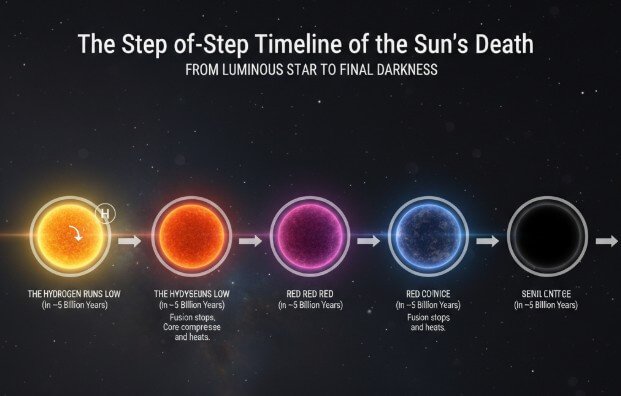
Here is the step-by-step timeline of what scientists expect will happen.
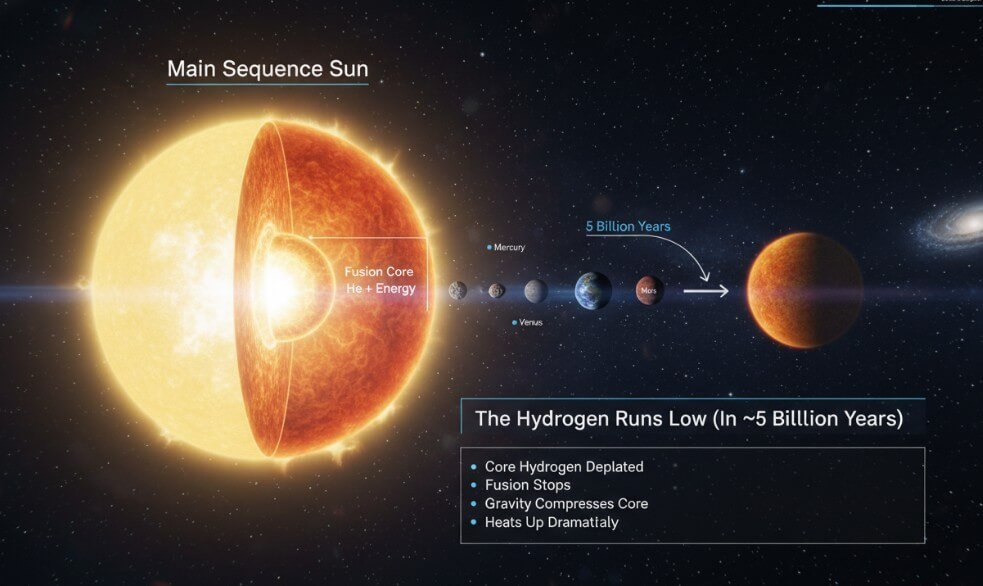
- The Hydrogen Runs Low (In ~5 Billion Years): After the sun converts all the hydrogen in its core to helium, the fusion process will stop. With the outward pressure gone, gravity will take over and begin to compress the core, causing it to heat up dramatically.
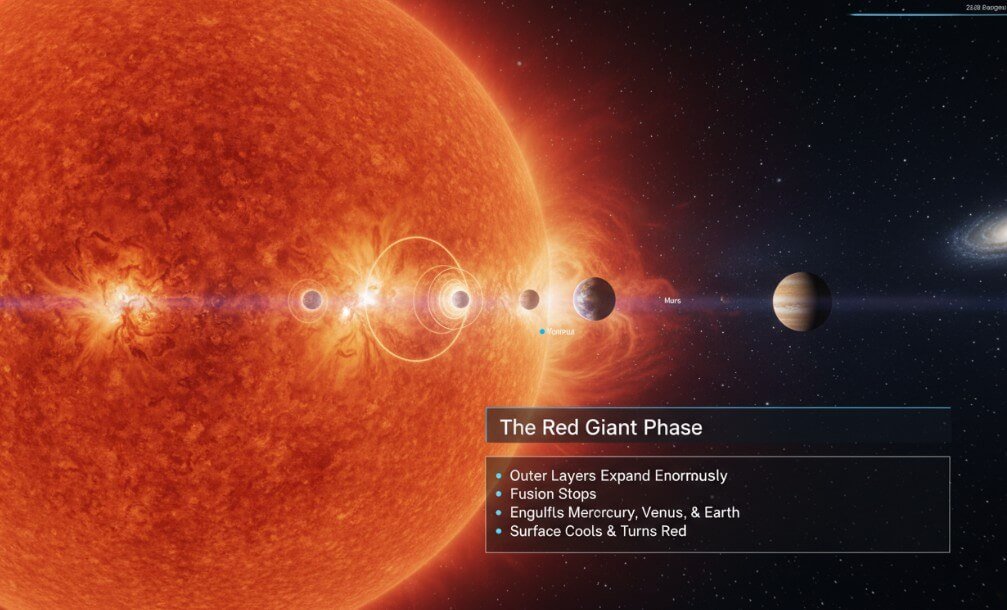
- The Red Giant Phase: This new heat will cause the sun’s outer layers to expand enormously, swelling to a size that will engulf the orbits of Mercury, Venus, and very likely Earth. As it expands, its surface will cool, turning it into a luminous but terrifying Red Giant.
- The Planetary Nebula: Following the red giant phase, the sun’s outer layers will drift away into space, creating an expanding, glowing cloud of gas known as a planetary nebula. These beautiful structures are common sights throughout our galaxy.
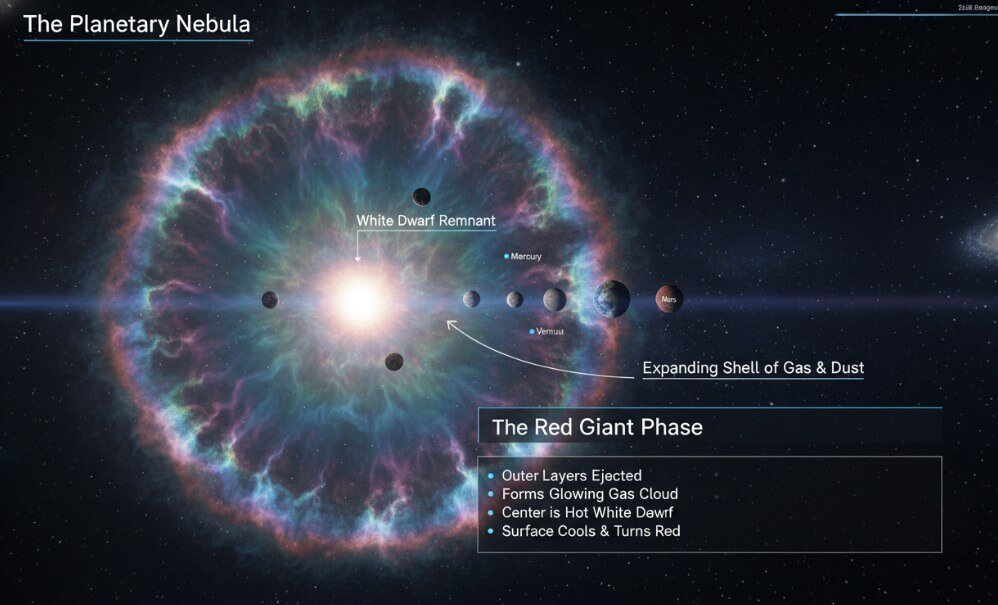
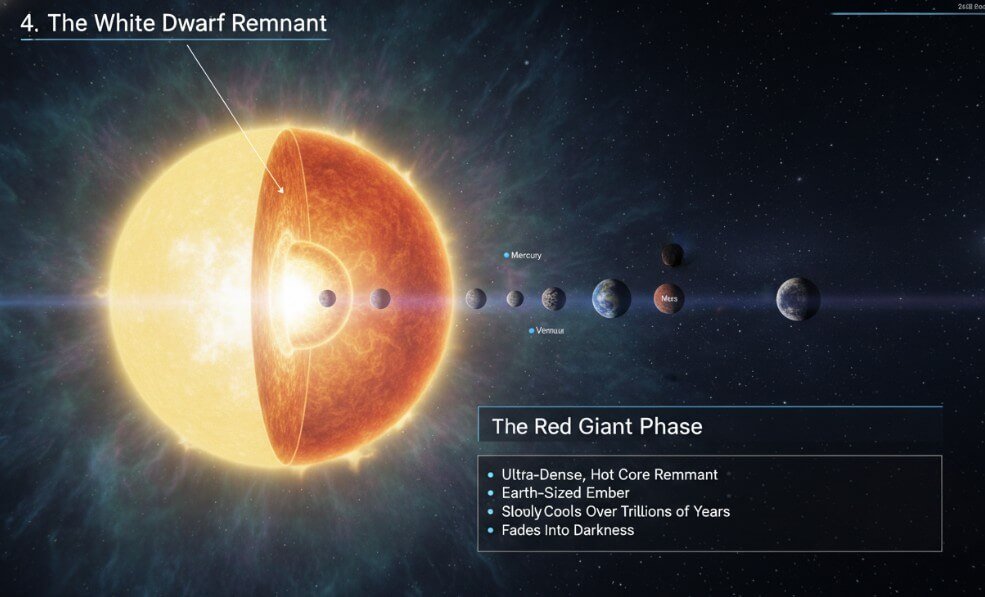
- The White Dwarf Remnant: All that will remain of our sun is its ultra-dense, scorching hot core, a stellar remnant called a White Dwarf. This Earth-sized ember will have the mass of about half the original sun. With no fuel left to burn, it will simply cool down and fade over trillions of years.
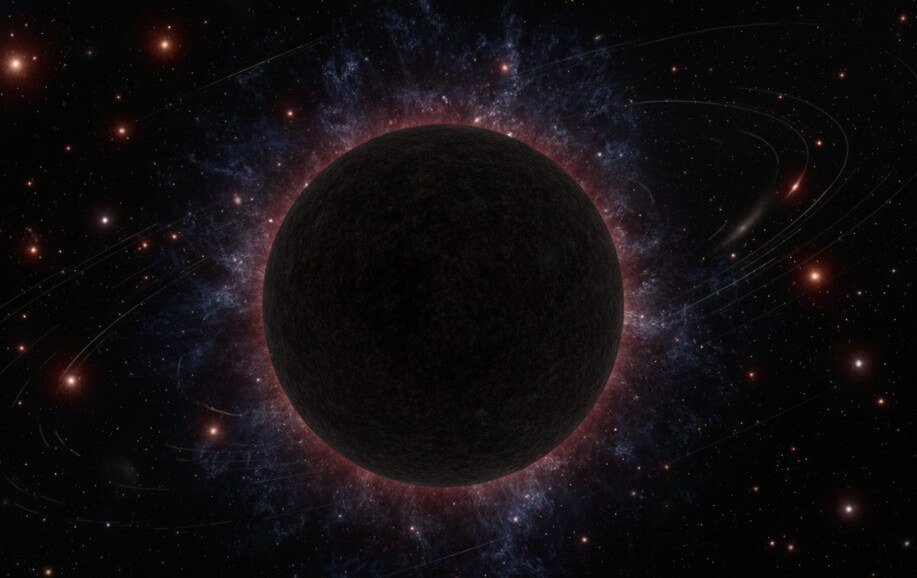
- The Final Stage: From White Dwarf to Black Dwarf: The story doesn’t end there. A white dwarf is essentially a celestial ember that cools over an almost unimaginable timescale. Over trillions of years—far longer than the current age of the universe—it will radiate away all its remaining heat until it becomes a cold, dark, and inert object known as a Black Dwarf, the theoretical final state of a star like our sun.
What Does This Mean for Earth?
Long before the sun becomes a red giant, its gradual increase in brightness will have catastrophic consequences for our planet. The Sun about 1 billion years before the sun’s growing luminosity makes Earth’s surface too hot for liquid water to exist.
Scientists at NASA predict that this 10% increase in brightness will be enough to boil away our oceans and turn our blue planet into a scorching, uninhabitable rock, ending all life as we know it.
A New Habitable Zone for the Solar System?
As the sun expands into a red giant, its habitable zone—the region where liquid water can exist—will migrate outwards. This raises a fascinating possibility.
For a brief period of a few hundred million years, the icy moons of Jupiter and Saturn, such as Europa and Titan, could warm up enough for any subsurface oceans to melt and exist as liquid on their surfaces. While Earth’s story will have ended, new, temporary potential for life could spring up in the outer solar system.
Frequently Asked Questions About the Sun’s Future
Q: Will the sun explode into a supernova?
A: No, the sun is not massive enough to explode as a supernova. That dramatic fate is reserved for stars at least eight times more massive than our sun. Instead, it will shed its outer layers peacefully to form a planetary nebula.
Q: Is the sun losing mass?
A: Yes. Through the process of nuclear fusion, the sun converts about 4 million tons of mass into energy every second. This process, along with the solar wind, causes it to lose mass over time. However, this amount is minuscule compared to its total mass and will not significantly impact its lifespan.
Q: How do scientists know all this?
A: Our understanding comes from decades of research into a field called stellar evolution. By observing millions of other stars at various stages of their life cycles, astronomers, like those at institutions like Cambridge University, can create and verify sophisticated computer models that accurately predict how stars like our sun will behave over time.
Conclusion
In summary, the answer to the question “is the sun burning out” is a definitive no—at least, not in the way we typically think of burning. Our star is a magnificent nuclear reactor with a predictable and well-understood lifecycle. While its eventual death in 5 billion years will reshape our solar system, the more immediate concern is the gradual warming that will make Earth uninhabitable in a billion years.
If you found this explanation helpful, please share it with others who might be curious about our star’s future, and leave a comment below with any further questions.

Love to read, explore and write about Science, Mathematics and Technology.
The name “Newton” coming from how I love Science.